
Bobby Gould-Pratt
This article will discuss plans to gear up the delivery of public places within the Quality Public Places (QPP) Programme which started approximately 25 years ago by the City of Cape Town’s Urban Planning and Design Department. While just over 105 spaces across Cape Town have been implemented via the programme to date, its success has been varied, with many obstacles to the implementation of public space being encountered which includes like many other African cities, limited budgets to plan and build as well as poorly aligned governance structures to ensure adequate maintenance and management of public space. In response to a critical review of the QPP programme, a range of proposals have been identified to initiate the shift to mainstream public space within the city administration. Two of these focus areas will be discussed in this article to demonstrate the approach being taken to gear up public space delivery within a continuing context of limited budgets, constrained resources and great community need.

Introducing the Quality Public Places Programme
Cape Town, located on the southern tip of Africa, is South Africa’s second largest economic node and is its second most populous city. The city is currently undergoing rapid growth and urbanisation which is intensifying a range of existing challenges including poverty, high unemployment and violent crime, as well as reinforcing its extreme levels of spatial inequality- a legacy of the former apartheid system.
As Cape Town moves towards overcoming these pressing challenges and realising its vision to build a City of Hope, which is defined in its various policy documents, as ‘a city that is prosperous, inclusive and healthy, where every resident can envision and realise a better future for themselves, their families and their communities,’ a focus on the performance of the public realm and the implementation of public space has an important role to play in achieving this vison.
As confirmed by UN Habitat in Place Making and the Future of Cities; ‘Building inclusive, healthy, functional, and productive cities is perhaps the greatest challenge facing humanity today. There are no easy solutions and yet a key part of the puzzle lies right in the heart of the world’s urban areas: the public spaces.’
The City of Cape Town’s Quality Public Places Programme, began in response to South Africa’s democratic transition in the late 1990’s with its founding ethos related to an imperative to contribute to a more just, dignified and liveable city as well as the need to address issues of inequality, spatial fragmentation and environmental degradation.

Targeted public realm interventions were identified and focused in locations of greatest social and economic deprivation, with these public spaces being purposely different from others previously developed in the city, in that they were positioned in structurally and symbolically significant locations while having the potential to integrate different communities, promote accessibility, support microeconomic opportunities or establish a new and positive sense of place.
All of the spaces intentionally adopted a holistic understanding of space that did not differentiate between municipal zoning designations.
They were multifunctional in nature as well as being minimalist, generative and catalytic. Typical public spaces projects included:
urban squares or forecourts at public transport or community buildings with amongst others, opportunities created for social and economic exchange as well as cultural commemoration;
multifunctional community spaces with street trading, markets, play courts and food gardens; and
street upgrades with a focus on improving pedestrian accessibility, safety and linkages between community facility clusters and public nodes.

While there have been many noteworthy achievements within the Programme including creating a greater awareness of public space, to promoting interdisciplinary collaboration on infrastructure projects as well as the receipt of several international awards in its early years, its overall impact has been varied. This in part relates to the reprioritisation of limited funding away from public realm improvement to address other competing demands in a rapidly growing city. The transversal nature of the QPP public spaces has also created blurred governance responsibilities between City departments that are predominantly arranged in silos.
The complexity of requiring different departments to co-ordinate various activities within a single space has been a contributing factor to the neglect and poor maintenance of many public spaces implemented within the programme. Further challenges have been to convince City departments to take on the asset owner function of many of the proposed QPP spaces leading to a slowdown of public space delivery within the programme from 2010 onwards.
High crime and a lack of personal security in Cape Town has also had a profound impact on public life and perceptions of public space across the city. Both public and private buildings are taking an inward focus, leading to blank walls and poor surveillance onto streets and public spaces. High walls and fencing as the favoured solution to secure facilities and spaces from vandalism further erodes public life by inconveniencing pedestrians as well as creating a disjointed public realm.
Material choices are also not only motivated by limited funding but also the need to be extremely robust to vandalism and theft leading to a lack of comfort and joy within the public realm.
Today, building on its founding ethos- which is still as relevant, the Quality Public Places Programme has expanded its focus to not only enable the implementation of place-making projects within the department but to also place emphasis on enabling and supporting all public realm partners in developing an integrated and sustainable public environment. Moving forward particular emphasis is being placed on pilot projects to demonstrate practical as well as innovative place-making solutions that others can be easily replicate. A range of separate but linked workstreams have been identified that will direct future work within the Programme with the specific objective of integrating and concentrating efforts towards promoting quality public realm outcomes.
In starting to gear up for increased public space delivery, a strategic approach has been adopted which acknowledges upfront that not all the solutions to existing challenges within the programme can be solved at once. Current emphasis is being placed on both top-down and bottom-up initiatives.
Vision and Direction: Establishing a Citywide Public Space System
A key area of focus in building a case for increased public space delivery is to establish existing and future public space needs. Empirical data and facts are required to convince decision makers which is particularly challenging when people have different perceptions of public space- including practitioners of the built environment!
While public space is generally accepted as “places which are publicly owned or of public use, accessible and enjoyed by all for free and without a profit motive,” it can take many spatial forms as well as being a social construct that is shaped by differing users values, beliefs and requirements, making it particularly difficult to define as well as quantify. It is critical to move away from reactive to proactive planning for public space provision that recognises the overlapping, fluid and multifunctional dimension of public space as well as its structural function.

Building on the recommendations in the Global Public Space Toolkit prepared by UN-Habitat, a ‘public space system’ is being developed for Cape Town as part of its Metropolitan and District Planning Review process. This layer will allow public space, including open space, streets, markets and public facilities to be purposely conceptualised as a separate and independent system, while also showing its linkages and dependencies to the other functional networks within the city.
Historically public space has been indicated within other various traditional mapping layers like the green infrastructure network, access system and public facilities network, which although correct has meant that it gets ‘lost’ and not properly accounted for. Giving the public space system status within formally recognised planning instruments will start to institutionalise public space with the City administration, which is critical for it to be properly funded and accounted for.
Defining the public realm and the range of public spaces within it, is also becoming increasing critical as City of Cape Town policies continue to promote densification and infill development to support greater urban efficiencies. A clear vision on the location, character and quality of the public realm and its network of public spaces is required to give guidance for both green-field and brown-field development to ensure liveable neighbourhoods.
A fundamental shift of the ‘public space system’ approach will be for all the typologies of public space within an area to be holistically considered and the opportunities of the collective to emerge in identifying potential place-making opportunities, particularly when vacant open land is limited and creative solutions are needed.
Demonstrate: Prioritisation of Living Streets as a public space typology for Implementation

The second area of focus relates to the prioritisation of street regeneration projects. These projects are termed ‘living streets’ and are being specifically targeted as there is limited vacant public land available to provide functional public open space, particularly in existing poorly resourced parts of the city where current intensification is predominantly occurring. It is critical that existing roads which can take up to 30% of the total developable land area for a neighbourhood are better planned to serve community needs. In many cases, streets now present the only opportunity to provide social and recreational space as well as opportunities to support emerging micro economic activity.
These projects are also being targeted as bulk infrastructure in many parts of the city is failing due to age or is inadequate for the growing demand created by intensification. In these locations, the infrastructure which predominantly lies under streets, needs to be replaced. This presents an opportunity to optimise limited public investment to influence more interdisciplinary and multifunctional approaches to street design and ensure potential place-making opportunities are not lost.
A focus on street upgrade projects is also a precursor for supporting community stabilisation in neighbourhoods with greatest crime and social dysfunction. Ensuring that streets are clean, safe and attractive will bring dignity and hope.


Typically, street improvement projects within the programme have focussed on the area within the street reserve (public land) and do not include the spaces and properties abutting the reserve, which are also integral to supporting safe, walkable and active environments.
A more holistic approach to undertaking street improvement projects is required, where equal focus is given to enabling changes adjacent to the street reserve as well as within it. In many cases the solution to creating liveable streets lies in a partnership between the public and private, that begins with a broader contextual understanding and is expressed in a holistic street vision that outlines the required range of sequenced actions from both public and private actors.
This approach has been explored in several projects, with the Ingulube High Street project being a good case study. Located in Philippi, with one of the highest crime rates and greatest socio-economic deprivation in the city, the street forms a key link between a large public transport interchange and a key metropolitan activity corridor making it an intense hive of activity. The street struggles to perform adequately for a range of reasons with a dominant factor being its original layout, which prioritises cars above people.
Sidewalks widths are inadequate for both street trading and pedestrian use, leading to unsafe and unhygienic conditions for its users. In some sections, access to properties lining the street is taken from behind, leading to blank facades and an inability for property owners to easily optimise the economic opportunity occurring on their boundary.
A holistic review of the street has been explored that proposes not only changes within the street reserve but consideration of the abutting properties on the street edge. Rezoning and other town planning mechanisms to allow property owners to easily respond to economic opportunity as well assist with making an active street interface are identified, while proposals to allow the street to better serve all user needs including vehicular, pedestrian, trading and recreational in a healthy, safe and dignified manner are proposed.


This includes converting the street into a one-way route to create sufficient space for trading and pedestrians as well as much needed place-making opportunities.
Existing public spaces at key intersections along the route have also been identified for upgrades which were originally constructed in the Programme in the early 2000’s. Realising this Living Street vision will take time, buy-in and trust from communities. Current initiatives are focused on community stabilisation and capacity building as well as a focus on addressing inadequate municipal services before public realm improvements can commence.
A range of other street regeneration initiatives, located in differing contexts across the city are in various stages of planning and conceptualisation from St Georges Mall within the city’s historical centre, to Spine Road in Khayelitsha- a township on the outskirts of the city.
All of these projects are being conceptualised and planned with external partners and stakeholders which is an essential element to ensuring their long-term sustainability and success. The intention is to entrench and mainstream this more holistic approach to street improvement to realise a network of active, safe, green and memorable streets across the city.
Next steps and Lessons for the Future
The QPP programme was founded on a recognition that public space needs to be planned and managed in a transversal and collaborative manner which in turn invites complexity and the delivery of successful spaces a challenge. This in many ways was an ‘achilles heel’ of the Programme which led to a slow down of public space delivery when they were not properly maintained and managed.
The examples discussed in this article to support the mainstreaming of public space within Cape Town and to kick start increased public space delivery in the QPP programme, are still transversal in nature as it is a core element of public space.

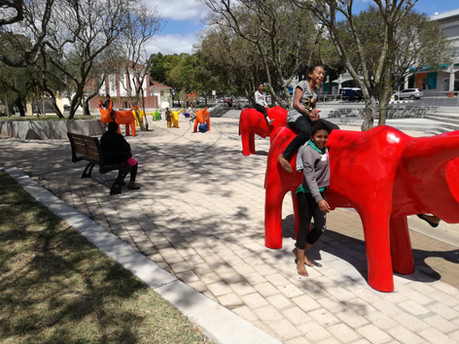


The key difference 25 years on, is that although there is appreciation for public space, there is a recognition that the city administration must also be ready and structured to receive them. Significant focus is therefore being given to ensuring that public space is treated like other infrastructure services to ensure it is adequately accounted and planned for.
A reflection on the lifespan of the QPP programme demonstrates that there are no simple solutions to place making. The spaces that have endured are the ones that had both institutional structures in place to support them as well as communities to receive and value them. Moving forward the selection of public space projects for implementation needs to be strategic and targeted to optimise limited resources as well as to show case the value of public space within the programme. It can be argued that any type of well-planned public space project will make a difference, however in Cape Town, or any country in the Global South there isn’t this luxury.
Living street projects have the ability to maximise limited resources as well as having the potential to make profound changes to improving the liveability of neighbourhoods and the lives of ordinary citizens, if they are not planned as infrastructure or engineering projects but conceptualised as places of social and economic enablers of change.

Download the full article here