
Abigail Kemper; Dora Hegyi; Yuming Pan
Rundu is a town in the North of Namibia, on the Okavango River. Despite having a perennial source of water, Rundu town residents often face water shortages, where the taps run dry. A representative of Rundu Town Council stated, “We cannot say with certainty why we are losing water”. The artisans and technical managers have a good sense of the areas where they attend to the most water leakages, defective meters and illegal connections, however the data or evidence of this is lacking. This limits the development of evidence-based plans and undermines the ability to justify budget requests or secure external funding. Together with Rundu Town Council, UNITAC identified the need for a digital solution to capture data by artisans attending to water and sanitation related jobs. The uptake of the Digital Job Card in Rundu Town Council is expected to enhance service delivery and water loss management by enabling accurate data collection, streamlined database integration, real-time performance monitoring via dashboards, and proactive task management through customizable notifications.

Why do the taps run dry?
Residents in Rundu do not understand why the taps run dry when their town is settled alongside the Okavango River, bordering Angola. The river sustains the community as a source of clean water as well as fish, and “Rundu is famous for its beach” according to local town representatives. It is an attractive tourist destination, and the urban population has grown at a rapid rate from 25,500 in 1999 to 118,000 in 2024, making it the second in size after the capital, City of Windhoek.
Despite having a perennial source of water, residents often face water shortages. Approximately 50% of Rundu residents live in informal settlements according to the local authority. In Ndama Informal Settlement, communal stand pipes with prepaid water meters supply the community as well as private households from in formal settlement areas. Many households collect water on foot or with spaghetti pipes (illegal connections tapping into the municipal supply system). The formal and illegal connections experience low pressure in the pipes and as a result, inadequate and unreliable water supply.

Rundu Town Council is responsible for upgrading informal settlements in the town boundary and delivering basic urban services to residents, businesses and organisations in Rundu as provided for in Section 30 of the Local Authorities Act (Act 23 of 1992) as amended for the administration of Local authority affairs within the proclaimed Local authority area of Rundu. This includes supplying water and sanitation services to informal settlement residents. At the same time, the Town Council is mandated to recover the costs and generate revenue from these services. However, the estimated water leakage index for Rundu is between 26 - 34%.
This indicates a high rate of water losses for which no revenue is collected. Furthermore, the Town Council has accrued a debt of N$ 333 million (approx. USD 18.7 million) with the country’s bulk water supplier, NamWater as of March 2025 according to Petersen S (2025). A representative of Rundu Town Council stated, “We cannot say with certainty why we are losing water”. This is a multi-faceted problem which requires a deeper dive into the water supply and demand side issues.
A detailed evaluation of the available data, interviews and site visits to Rundu were conducted by the United Nations Innovation and Technology Accelerator for Cities (UNITAC) between November 2024 – March 2025. The local authority and bulk water supplier, NamWater have plans to extend the water supply infrastructure. However, several data management and data collection issues remain. Installing bulk meters at each supply point will enable the town to check whether the total volume of water received from NamWater is as much as the Town Council is being billed for.


The artisans and technical managers have a good sense of the areas where they attend to the most water leakages, defective meters and illegal connections, however the data or evidence of this is lacking. This limits the development of evidence-based plans and undermines the ability to justify budget requests or secure external funding. Additionally, on a household scale, some customers with water meters have raised concerns that the readings and charges on their meters are inaccurate. This is cited as one of the reasons why customers are not settling their accounts.
A People Centered Smart City approach
Rundu is one of four local towns in Namibia where the BMZ-funded UNITAC project “Just transitions in vulnerable places” is exploring digital and urban data solutions to improve enhanced evidence-based decision making. It builds on and supports the work of various existing urban initiatives in Namibia, aiming to improve the information base for effectively enhancing climate resilience of informal settlements through mapping, data collection, data management, data governance and provision of climate smart basic infrastructure in informal settlements.
Since 2023, the Ministry of Urban and Rural Development has supported this project and the local adoption of digital and data solutions needed to upgrade informal settlements. The combination of national government support and the possibility to explore various use cases at the local government level has given the project legitimacy and flexibility to examine the unique needs of local towns and iteratively develop and collaborate with local stakeholders, such as the Namibia Housing Action Group and GIZ ISUD programme.
Adopting a user-centered Design Thinking approach ensured that the development of digital and data solutions was not tech-driven but focused on real human needs, exemplifying UN Habitat’s People-Centered Smart Cities model.
UNITAC and Rundu Town Council identified the delivery of water services as one of the main local challenges and priorities in Rundu related to building climate resilience in informal settlements. Based on several engagements with the Technical Management including the Finance Manager, user needs assessments and the detailed evaluation of available data, a solution for digitally capturing data by artisans attending to water and sanitation related jobs was desired.
Similar challenges related to data management, but varying use cases and priority areas have been reported across different town councils and various departments. Following the design thinking process, a versatile digital tool named ‘Digital Job Card’ has been conceptualized, developed and tested to fulfill these diverse needs.
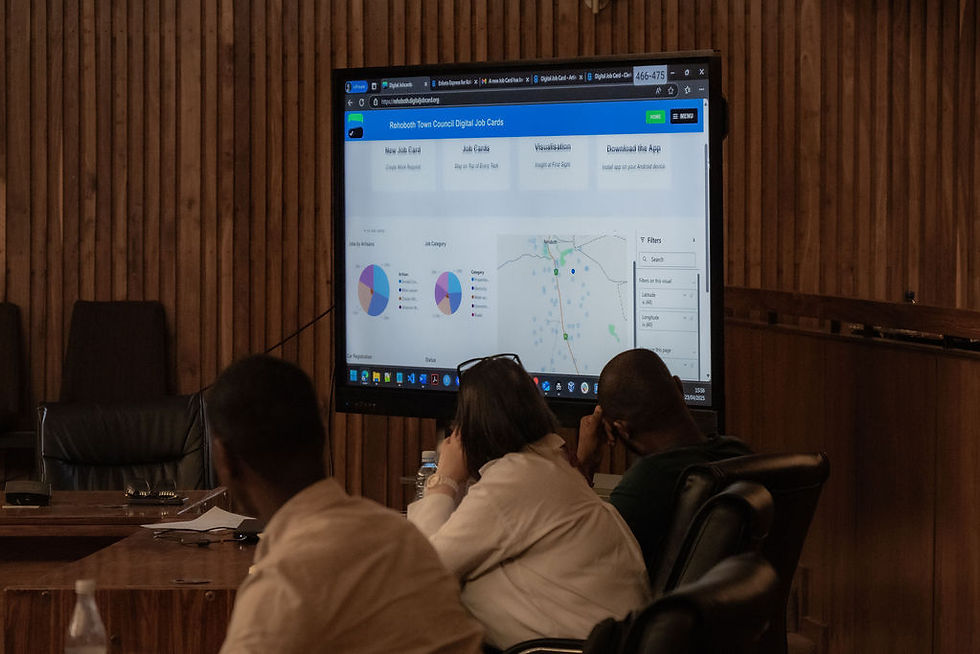
The Digital Job Card is a web and mobile application designed to work both online and offline. The app digitalizes the process of creating and tracking job cards for different urban services or issues such as water infrastructure maintenance, electricity fault reporting, or building inspection for local authorities in Namibia.
With this system, technical staff and clerks can track and report on the completion of their tasks or the status of an issue, allowing supervisors and managers to have sight of the data in near real time. The collected information can be used for monitoring processes, data management, analysis and visualisation, thereby improving information accessibility and evidence-based decision-making, planning and service delivery.
The prototype was developed in collaboration with Rehoboth Town Council initially, another partner town of the project. Like Rundu Town Council, the technical management team participated in user needs and ideation workshops, as well as user testing sessions. The prototype was developed with scalability in mind. It was intentionally designed to be easily customizable by other towns and simple enough to adopt in the business processes of one division or multiple divisions of the local authority.


The mobile application leverages KoboToolbox for offline data collection and enables town councils to create and edit forms autonomously. The app also integrates customised components for user authentication and real-time notifications. Apache Superset is used for data visualisation so that town councils can easily monitor KPIs, as well as detect operational bottlenecks, hence contribute to efficient resource management.
With accurate records of water services and issues, Rundu will be able to improve service delivery
The uptake of the Digital Job Card can have a very positive impact upon service delivery and improve the ability of Rundu Town Council to better manage water losses. The Council will also be able to communicate to residents, how and where the water network requires repair, and what options they have to purchase a water connection or collect water. This will go a long way to improving service delivery.
There are four components of the tool, which have a positive impact on service delivery. The first component is data collection. More accurate location data is collected using GPS functionality of the Digital Job Card. Previously the artisan manually captured the address or description of the location, however the common names for street addresses did not always match the cadastral information and could not easily be mapped, limiting the ability to conduct any geospatial data analysis.
Furthermore, digital forms adapted from paper-based system can be easily created and customized in a no code/low code environment. They support interactive question formats such as conditional logic, multimedia inputs and pre-filled options, which make data collection more efficient and accurate. Digital Job Card app streamlines data collection and storage, enabling structured, real-time input from the field with temporal and spatial dimensions. Data collected can be exported directly or through API by admin users for downstream analysis.

The second component is the dataset. Datasets collected through Digital Job Card APP brings town councils closer to establishing an integrated database, that consolidates various data sources, including cadastral and consumer information.
The third component is the dashboard. The dashboard, like other business intelligence tools offers users an overview of important metrics or indictors. For example, the technical manager can monitor response times – calculated as the time from when the job was assigned to the time it was completed.
The visualized data also serves the reporting requirements. Supervisors who used to manually generate charts and graphs to report the monthly or weekly activities of their service teams, can now do so at the click of a button.
The fourth component is theommunication and workflow. Email and SMS notifications are set to the user’s preferences. For example, it may be set to alert the Manager when a new task is assigned and or completed, or only when the number of incomplete or unassigned tasks exceeds a certain threshold warranting attention from the Manager. This has a positive impact on more effective management and service delivery improvements.
Previously, the workflow required artisans to collect request form in the front desk and obtain hand signature or in-person approvals upon job completion. This process can lead to delays, particularly when managers are not available or out of town.
With 6-12 months of data collected by artisans using the Digital Job Card in the field, the Head of Water and Sanitation will be able to assess where specific jobs and issues are most prolific and in which season. It is expected that over time, evidence of where water leakages are most often repaired will indicate aging infrastructure. Evidence of where new water connections are installed, illegal connections are removed, or broken water meters are common, will all significantly contribute to the town’s ability to manage water losses and plan appropriate interventions. This data can also help motivate for budget and finances to prioritise such interventions.
The Digital Job Card is ready for uptake in other towns with the same aim to improve service delivery
The uptake of the Digital Job Card in Rundu Town Council is expected to enhance service delivery and water loss management by enabling accurate data collection, streamlined database integration, real-time performance monitoring via dashboards, and proactive task management through customizable notifications.
Much hope rests in the possibility for innovation to address Africa’s challenges, (Adesida et al 2021) and this is a real-world example. However, the impact of this project will be determined by local commitment to use the tool in their daily operations. The value and quality of the data collected will only be as good as the users let it be. The uptake of the tool needs to be driven by the Technical Managers and supervisors who are responsible for using the tool and instructing artisans to use the tool.
The Digital Job Card’s innovation lies in its simplicity. The application is easily customisable in a no code/low code environment and it is easily scaled to other towns and multiple business processes. It allows local authorities (especially secondary towns unable to implement city scale solutions) to take one step at a time in the direction of digital tools and services.
This simple tool catapults the ability of local authorities to improve service delivery by communicating real-time service-related requests and status updates within the local authority and with customers. And by creating access to information and service performance data which informs better urban planning and sustainable infrastructure planning.
Other towns and local governments are invited to contact unitac@un.org to find out more about implementing the Digital Job Card in their daily operations.
Download the full article here