African Cities Magazine 7
October 31, 2026
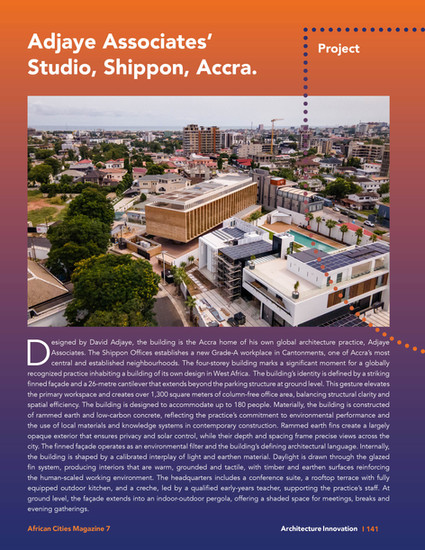
This Seventh edition explores how African cities can finance and deliver their rapidly growing urban needs. Its special issue, Financing Cities in Africa, moves beyond the question of access to capital to examine the institutions, governance, project preparation, local revenues and partnerships required to turn urban priorities into investable projects. Through expert interviews and case studies, it addresses municipal finance, housing, infrastructure, diaspora investment, Chinese engagement, informal economies, cadastres, territorial finance and rapidly urbanizing corridors. Concrete experiences from Cotonou, Lagos and other contexts highlight emerging approaches to financing urban transformation. Beyond finance, the edition showcases innovation in urban planning, mobility and multidisciplinary practice, alongside new architectural responses including 3D printing, bioclimatic design, market transformation and contemporary African architecture. A final section examines architectural and urban heritage, exploring how preservation, redevelopment and financing intersect in cities including Lomé and Lubumbashi.
Reform economic governance
The building blocks and strategies for sustainable urban transformation across the African continent are already in place. The key is to tailor governance to harness these opportunities and turn them into tangible actions. Welcome to this new edition of your annual magazine on urban dynamics in Africa. This seventh edition deals with a subject at the crossroads of urban development issues in Africa: financing. Indeed, it is a central point in the march towards more inclusive and sustainable cities. This issue aims to provide diverse viewpoints on urban funding by examining the perspectives of various stakeholders and exploring cutting-edge financing methods.
This edition reveals that the cities on the continent are economically vibrant and prosperous. The challenge is to turn this economic wealth into financial wealth to finance infrastructure and services. To achieve this, local elected officials must be particularly agile and innovative. They must know their territory and its specificities to make it engines of growth. Luc Gnacadja, mayor of Cotonou, defends this position, stating that local financing must begin with a city that can accurately identify its territory, maintain its assets, and mobilize its resources. Khadija Mahecor Diouf, the mayor of Golf Sud in Dakar, shares this vision, referring to it as an “enterprising municipality”. This term describes a municipality that begins by gaining an in-depth understanding of its territory, then proceeds to the strategic mobilization of capital for the execution of projects. This awareness requires us to stop fighting the tide by pursuing a dream vision of cities aligned with exogenous models. Dr. Pierre Nguimkeu’s narrative proposes a paradigm shift, particularly in terms of what is too often wrongly described as informal. For him, it is not an anomaly to be corrected or a sector to be formalized. The real challenge is to increase their productivity, their income and their security by investing in urban and economic infrastructure that is adapted to the situation. In this paradigm shift that emphasizes endogenous growth, Dr. Bolaji urges us to harness the collective efforts of the African diaspora. This valuable resource is crucial for the prosperity of our cities, but only if we can align our visions. Therefore, it is imperative that we reform economic governance to address these challenges. As Carlosde Freitas of the FMDV explains, the answers are already at our fingertips. The real challenge, however, is to create institutions that can assemble them around territorial priorities and capabilities.
Your magazine, as you will have understood, crosses interviews with actors of change on the continent with lessons learned from projects and research on the challenges of financing cities in Africa. You will also find inspiring reflections on how to transform and preserve our living spaces in the urban innovation, architecture innovation, African architecture and urban heritage sections.
We are looking forward to seeing you on 31 October 2027. We wish you a pleasant read. On behalf of the Africa Innovation Network, we are happy to receive your contributions and feedback regarding topics of interest.